From the Farmstead with Mark Wieser
Food has a way of carrying memories of the seasons, family kitchens, and of the land itself. In this ongoing series, Fischer & Wieser co-founder Mark Wieser reflects on growing up on the now Fischer & Wieser Texas Hill Country farmstead and the foods that shaped his life. Through personal stories, regional history, and a deep love of flavor, Mark shares how tradition, curiosity, and a sense of place continue to inspire the products we make today.
Oktoberfest Arrives in the Texas Hill Country
Fall is beginning to make itself known in Fredericksburg. The days are getting shorter, the mornings a little cooler, and before long the big tents will be going up on Marktplatz for Oktoberfest. Held each year on the first full weekend of October, it has become one of those traditions that signals autumn in the Texas Hill Country.
From a Royal Wedding to a German Tradition
Oktoberfest is not as old a tradition as some might think. The first was held in 1810 in honor of the marriage of Bavarian Crown Prince Ludwig, who later became King Ludwig I, to Princess Therese of Saxe-Hildburghausen. The citizens of München (Munich) were invited to join the festivities, which culminated in a great horse race on fields outside the city gates. The celebration proved so popular that it was repeated, and Oktoberfest was born.
Bringing Oktoberfest to Fredericksburg
Fredericksburg’s Oktoberfest is considerably younger. The Pedernales Creative Arts Alliance held the first one on Marktplatz in 1981. It has since become such a part of our community that one might say you haven’t really experienced Fredericksburg until you’ve attended Oktoberfest.
Experiencing Germany’s Great Beer Festivals
I have been to München many times, but I have never attended Oktoberfest there. I have, however, attended the great beer festival in Stuttgart, and it was unbelievable! Each brewery served its beer in its own gigantic tent. There were a dozen or more that seemed large enough to dwarf a circus Big Top. Inside each was a dance hall with a band and a restaurant. Women wearing Dirndls carried liter-sized glasses of beer, four or five clutched in each hand, through a joyous crowd.
Outside were dozens of colorfully decorated booths featuring every imaginable German food, including enormous pretzels. It was quite a sight and reminded me of my first visit to the world-famous Hofbräuhaus in Munich.
How Oktoberfest Helped Our Growing Business
Oktoberfest holds a special place in our hearts because, in our early years of business, Fredericksburg’s festival helped us immensely.
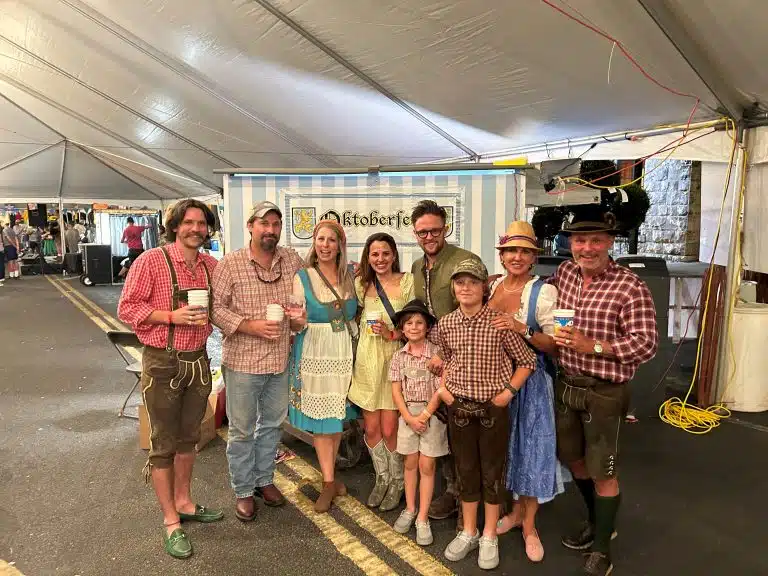
Case and I would put on our Lederhosen and German hats. Deanna had her own Dirndl dresses, handstitched by Jane Woellhof using authentic materials from Germany. At first, we had just 10-by-10-foot space, but soon we were allowed to set up a larger one.
The Festival Debut of a Signature Sauce
Oktoberfest inspired our Texas Beer Jelly, and it was there that we first introduced our Original Roasted Raspberry Chipotle Sauce. We knew we had something special because people began buying it by the case. We kept having to leave the festival, go back to the warehouse and bring more.
It was one of those moments in business when the customer tells you something before you quite know it yourself.
Making Apple Butter in the Old Black Kettle
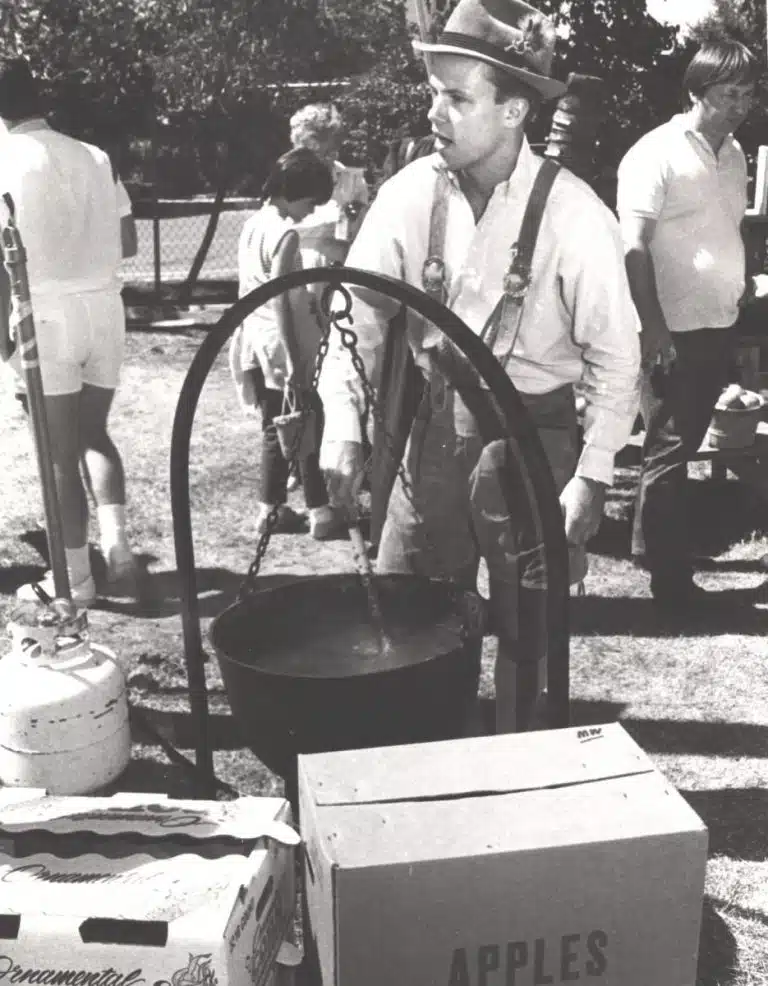
Another part of our Oktoberfest display was a large black kettle in which we demonstrated how to make old-fashioned apple butter. Apple butter is a thick, spreadable preserve made by slowly cooking apples with sugar and spices until the fruit turns dark and concentrated. The wonderful smell of apples and spices cooking slowly over the heat attracted visitors to our booth. Some occasionally snitched a spoonful here and there. It was a lot of work, but for years we looked forward to doing it.
How Apple Butter Became Part of Our Story
Interestingly, apple butter was not something I ate growing up.
My father planted dozens of apple trees, but we never used them for apple butter. Many produced green apples. They were tart and made the best cobblers and pies because they maintained their crispness. The Red and Yellow Delicious we grew were generally sold.
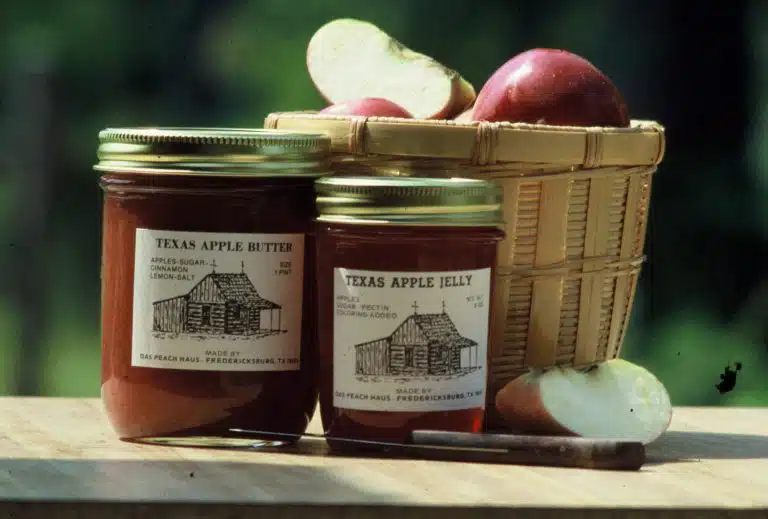
When Case returned home from college and we began expanding what we made and sold at Das Peach Haus, fruit butters became part of the business. Surprisingly, no apple butter recipe had ever been submitted to our old Fredericksburg Home Kitchen Cookbook. My sister-in-law Jean Wieser created our recipe. Even before our Oktoberfest demonstrations, she and Case would make apple butter outside Das Peach Haus in a large kettle.
The Old-World Tradition of Apple Butter
That old-fashioned kettle method had a long history.
Apple butter developed in the apple-growing regions of Europe as a practical way of preserving the harvest. German-speaking settlers carried the tradition to Pennsylvania, where apple-butter making became a community affair. Preparing the apples could become a social occasion of its own, with families and neighbors gathering to peel, core and cut apples before they went into great kettles to cook for hours.
The apples were stirred with long wooden paddles until the fruit became dark, smooth, concentrated, and richly flavored. It was preservation, certainly, but it was also an excuse for people to gather. Perhaps that is one reason the old black kettle seemed so appropriate at Oktoberfest.
It is interesting that apple butter apparently never became much of a tradition among the Germans who settled Fredericksburg. Perhaps they did not know it, or perhaps they simply preferred their preserves another way. Whatever the reason, there was no apple butter recipe in the old Fredericksburg Home Kitchen Cookbook.
From Central Asia to the Texas Hill Country
Apples themselves have an even more complicated history. They originated in Central Asia, with the wild ancestor of our domestic apple associated particularly with what is now Kazakhstan. From there apples traveled with people along ancient trade routes and eventually spread throughout Europe.
The Surprising Science and Symbolism of Apples
They also became tangled up in Western art, literature, and religion. Although the Bible never identifies the forbidden fruit in the Garden of Eden as an apple, European artists eventually made it one. The Latin connection between malum, apple, and malum, evil, probably helped the association along.
Apples are members of the rose family, and one of their most fascinating qualities is that an apple grown from seed will not produce an exact copy of its parent. Plant a seed and you may get something entirely new. To preserve a particular variety, a branch, or scion, must be grafted onto rootstock.
The Texas German Meaning of Mus
One final bit of German language brings us back home.
Our old Texas German word Mus was used for jams, jellies and preserves. In standard German, Apfelmus generally means applesauce, but here the meaning of Mus broadened. It became part of the language of putting fruit away for another day.
Beginning Traditions of Our Own
And perhaps that is why apple butter and Oktoberfest remain connected in my memory. I can still picture that big black kettle, Case and me in our Lederhosen, Deanna in her Dirndl, and people stopping to see what smelled so good.
We thought we were simply selling preserves and sauces.
As it turned out, we were beginning traditions of our own.
Old-Fashioned Apple Butter Recipe
Ingredients
- 4 pounds good cooking apples, such as Granny Smith or Gravenstein
- 1 cup apple cider vinegar
- 2 cups water
- 4 cups white or brown sugar
- ¼ teaspoon salt
- 2 teaspoons cinnamon
- ½ teaspoon ground cloves
- ½ teaspoon allspice
- Zest and juice of 1 lemon
Preparation
- Core and quarter the apples. There is no need to peel them.
- Place the apples, water, and vinegar in a heavy-bottomed pot. Cover and cook over medium heat until the apples are very soft, about 20 to 30 minutes.
- Purée the cooked apples until completely smooth, using a blender, food processor or immersion blender.
- Return the purée to the pot and stir in the sugar, salt, cinnamon, cloves, allspice, lemon zest and lemon juice.
- Cook uncovered over low to medium-low heat, stirring periodically, until the mixture becomes thick, glossy and develops a deep golden-brown color. This may take 1½ to 2½ hours, depending upon the width of the pot and moisture in the apples. Stir more frequently as the mixture thickens to prevent scorching.
- To test, spoon a small amount onto a chilled plate. The apple butter should hold its shape without liquid separating around the edges.
- Spoon into clean jars and refrigerate. For shelf-stable storage, process according to current tested home-canning guidelines.
Apple Butter FAQs
How long does homemade apple butter keep?
Keep this recipe refrigerated in a clean, covered jar and use it within about two weeks. Freeze it for longer storage; only apple butter prepared and processed using a tested canning recipe should be stored unopened at room temperature.
How is apple butter different from applesauce?
Apple butter cooks much longer, letting moisture evaporate until the apples become darker, thicker and more concentrated in flavor. Despite the name, it contains no dairy butter.
What do you serve apple butter with?
Spread it on toast, biscuits or warm bread; spoon it over oatmeal or pancakes; or serve it alongside pork and sharp cheese.
Plan Your Fall Getaway to Texas Hill Country
Fall in Fredericksburg, Texas, is an unforgettable experience filled with vibrant festivals, outdoor adventures, and delicious culinary delights. From the excitement of Oktoberfest and the Fredericksburg Food & Wine Fest to the serene beauty of Enchanted Rock and the welcoming charm of Fischer & Wieser’s Farmstead, there’s no shortage of things to do.
Whether you’re planning a romantic weekend getaway, a family vacation, looking to explore Texas wine country or a solo retreat, make sure to include Fredericksburg’s fall events and outdoor activities on your itinerary. And don’t forget to visit Fischer & Wieser to take home a taste of Texas to savor long after your trip has ended.
Visit the farmstead
Can’t wait to explore the farmstead? Our doors are open Sunday 10 am-5pm, Monday – Thursday 10 am – 5:30, Friday & Saturdays 10 am – 7 pm.